

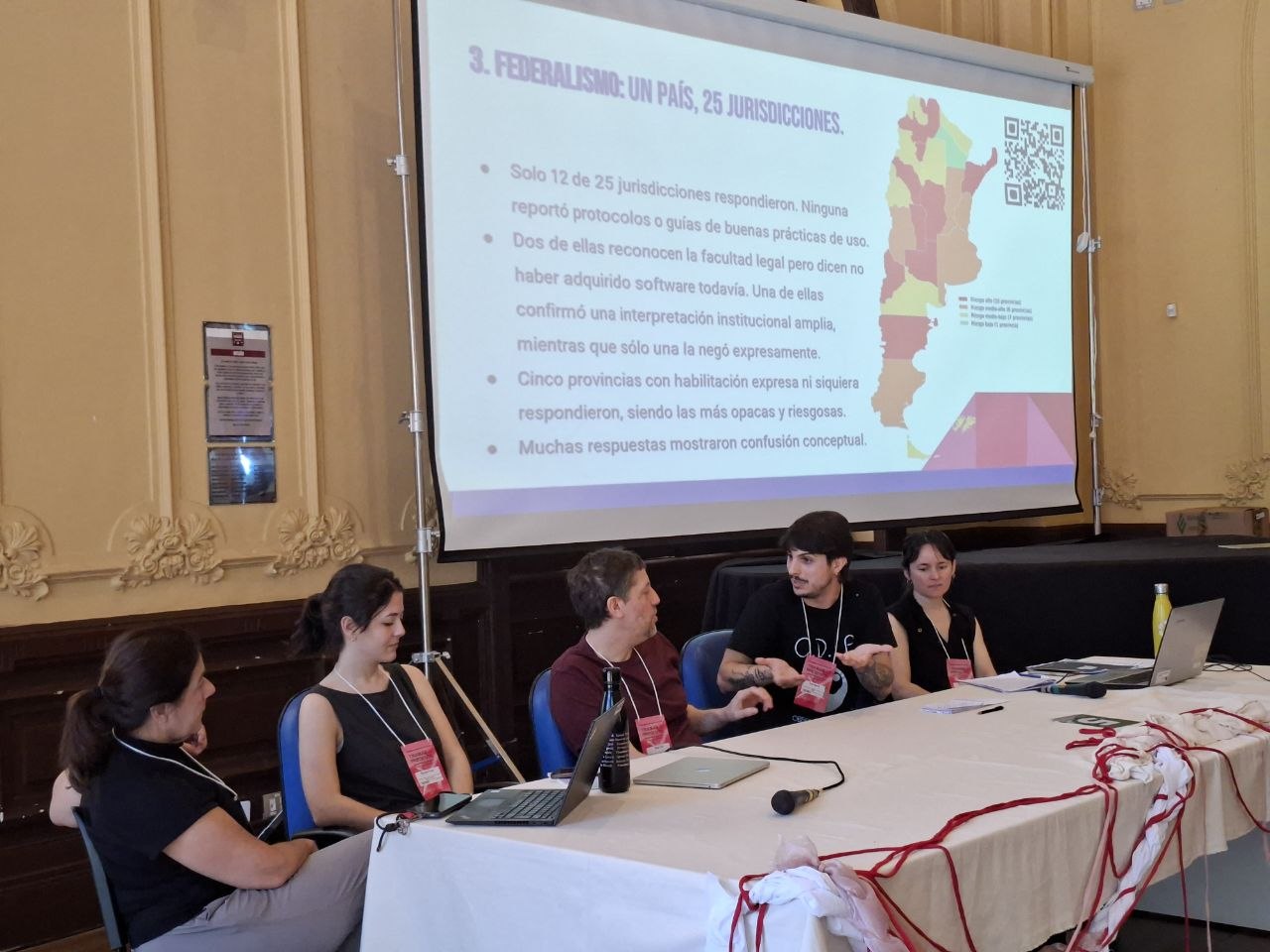
Vía Libre at Lavits, Rio de Janeiro, Brazil, Friday, August 28, 2026.
We presented the findings of two years of research into intrusive technologies in Argentina. In a panel titled “Cartographies of Opacity: Spyware, Public Procurement, and Regulatory Fragmentation in Argentina,” moderated by Beatriz Busaniche, representatives from all four organizations forming the research consortium gathered: CELS, Democracia en Red, ODIA, and Fundación Vía Libre.
The presentation opened with an overview of the surveillance landscape in Argentina, delivered by Margarita Trovato. Fragile regulatory frameworks, weak institutions, and a tendency to prioritize exceptional measures have fostered a state of near-permanent surveillance across Argentine territory. This normalization of mass surveillance is sustained by systemic opacity, deep interdependence between corporate and state actors, and ongoing threats to the personal data rights of both the general public and past victims of state surveillance. Recent intelligence reforms, expanded law enforcement oversight powers, cyber-patrolling, and the creation of the Artificial Intelligence Unit Applied to Security are just a few examples of Argentina’s expanding surveillance state.
Manuel Tufró (CELS) detailed the structural conditions escalating the risk of human rights violations linked to intrusive software. Technologies are adopted through expedited procedures alongside regulatory fragmentation stemming from Argentina’s federal structure, while a proliferation of national agencies severely hampers oversight capacity. Furthermore, despite being the primary purchaser of these technologies, the State remains at a disadvantage against vendor companies—failing to mandate auditing conditions or know-how transfers, which creates a dynamic of double opacity.
Conducting this research within a federal system presents significant challenges, as outlined by Tomás Rausch (ODIA). Argentina comprises 25 distinct jurisdictions with the authority to legislate and procure these technologies. Through this project, we developed a risk map of procurement and potential deployment of intrusive tech. The methodology relied on Freedom of Information requests, though only 12 of the 25 jurisdictions provided reliable responses; the remainder of the map was compiled through legal research and regulatory analysis. High-risk areas identified include the provinces of Chubut, Neuquén, Jujuy, San Luis, Corrientes, and Misiones, where existing legislation authorizes state procurement and deployment of spyware, yet safeguards or protocols to mitigate potential collateral damage are either non-existent or unprovided.
Finally, Florencia Caffarone, Executive Director of Democracia en Red, presented key baseline guidelines for the acquisition and use of spyware technologies. These include comprehensive lifecycle tracking of the technology, establishing technical and evidentiary standards for deployment, implementing strict protocols for handling obtained data, and conducting rigorous audits through procedures that publicly account for their adoption in criminal investigations.
Throughout this project, we have raised documented concerns regarding the inherent risks of state-acquired intrusive technologies—specifically the danger that these tools may bypass legal oversight and enable unlawful intelligence operations within the country.
Notably, this panel was the only one to address this issue at a high-level academic conference dedicated to surveillance studies. We extend our gratitude to the Lavits Network for providing the space to share these research findings with regional colleagues, made possible through the support of the Spyware Accountability Initiative (SAI).