

Reports

Digital and AI sovereignty: four evidence-informed cases; background paper
This paper can be cited with the following reference: Benotti, L., Busaniche, B., Gómez, M. J. and Trovato, M. 2026.Digital and AI sovereignty: Four evidence-informed cases. Paris, UNESCO. Paper commissioned to support the development of policy briefs on AI governance in education. © UNESCO 2026
More information at https://www.vialibre.org.ar/en/we-presented-the-paper-digital-and-ai-sovereignty-four-evidence-informed-cases-at-unesco/
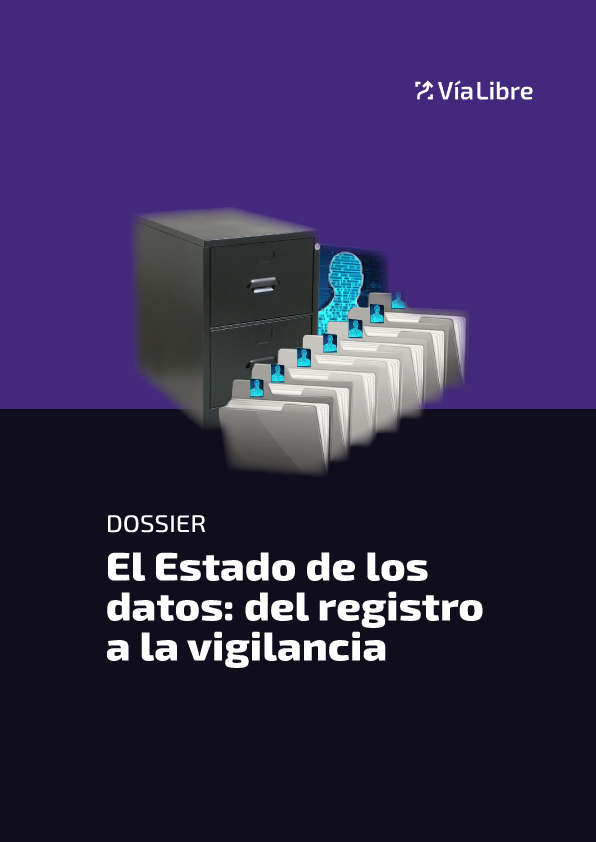
The State of Data: from recording to monitoring
This report analyses what the Argentine state can currently do with its citizens’ personal data and what safeguards exist against this power, in a context shaped by the use of technology.
It begins with a description of the data ecosystem that the Argentine state is currently building up, before going on to address the issue of inferred data. What is it? How is it protected? We take a look at the regulatory frameworks for data protection and their weaknesses, and then review some recent reforms that enable increased surveillance, with the aim of characterising and understanding the current landscape in which data processing technologies are deployed, and the associated risks in terms of citizens’ human rights.The State of Data: from recording to monitoring
Spyware Warning
Vía Libre, CELS, Democracia en Red and O.D.I.A. have drawn up this analysis, through which we aim to highlight the weaknesses in Argentina that put us at real risk of joining the list of countries where spyware is used for political persecution and the violation of fundamental rights.
Companies and governments claim that the use of spyware is limited to serious crimes, such as terrorism or organised crime. However, the number of cases of illegal use of this tool in countries as diverse as Saudi Arabia, Italy and the United States, and in our region in Mexico, El Salvador, Peru and Colombia, shows that once these tools are acquired by states, it is very difficult to prevent their deployment in illegal intelligence operations, even in countries with strong institutional frameworks.
Yearbook 2025
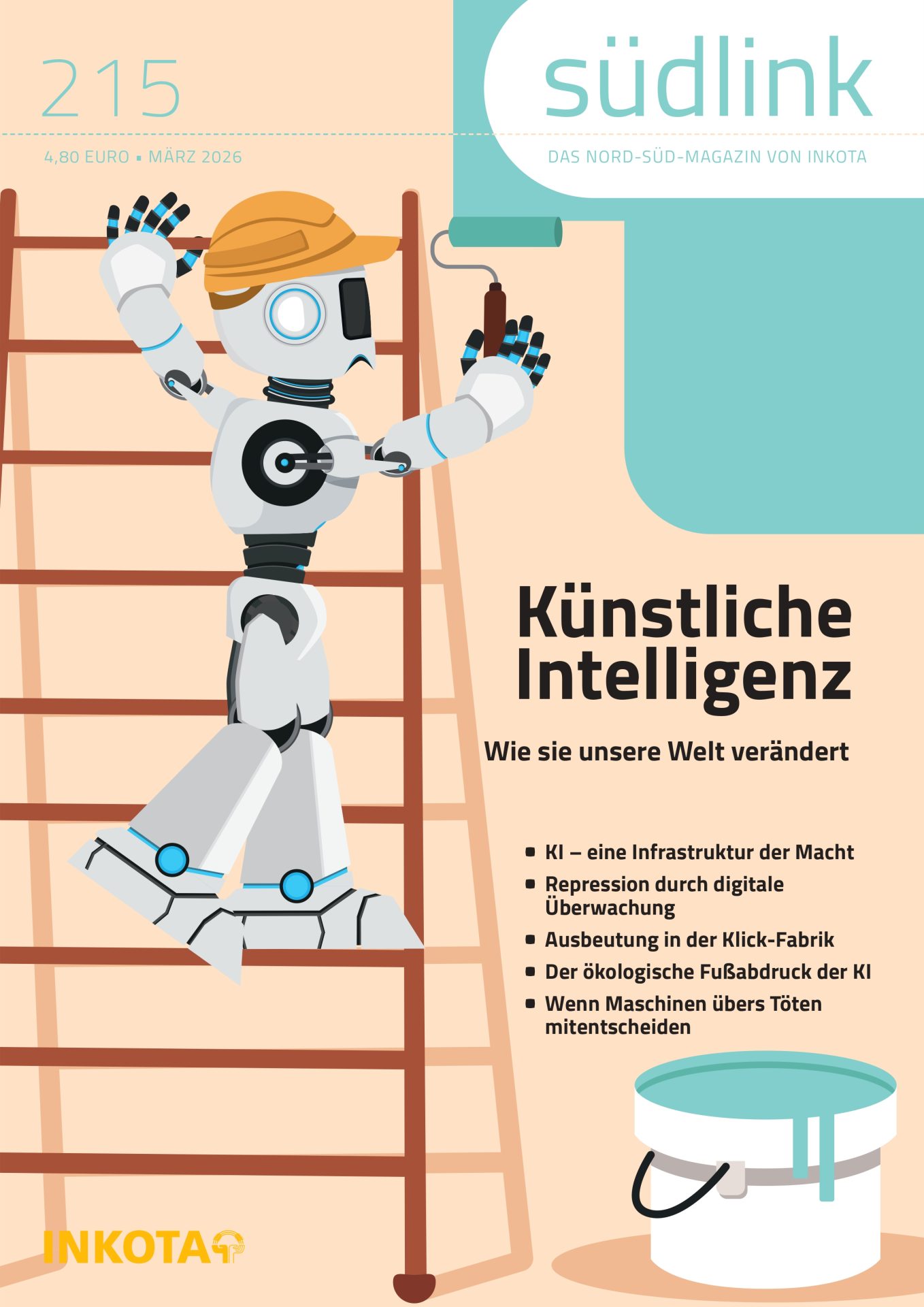
Artificial intelligence. How it is changing our world
We contributed to the publication ‘Artificial Intelligence: How It Is Changing Our World’ in the magazine ‘südlink’.
HESEIA: A community-based dataset for evaluating social biases in large language models, co-designed in real school settings in Latin America
Most resources for evaluating social biases in Large Language Models are developed without co-design from the communities affected by these biases, and rarely involve participatory approaches. We introduce HESEIA, a dataset of 46,499 sentences created in a professional development course.
The course involved 370 high-school teachers and 5,370 students from 189 Latin-American schools. Unlike existing benchmarks, HESEIA captures intersectional biases across multiple demographic axes and school subjects. It reflects local contexts through the lived experience and pedagogical expertise of educators. Teachers used minimal pairs to create sentences that express stereotypes relevant to their school subjects and communities. We show the dataset diversity in term of demographic axes represented and also in terms of the knowledge areas included. We demonstrate that the dataset contains more stereotypes unrecognized by current LLMs than previous datasets.
HESEIA is available to support bias assessments grounded in educational communities.