

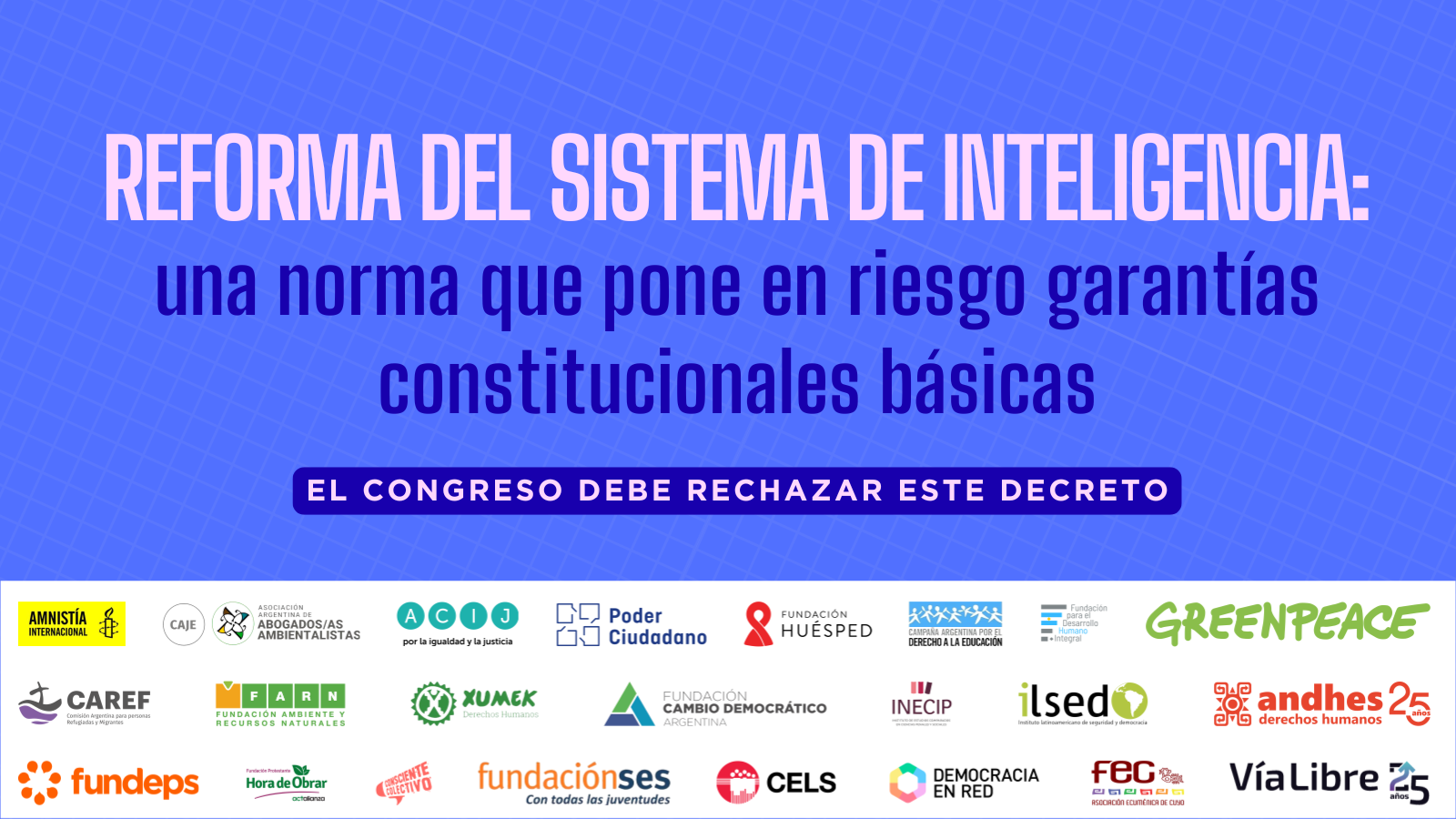
On 31 December, the Executive Branch issued Emergency Decree (DNU 941/2025), reforming the functioning of the Argentine intelligence system. This was not done through a law debated in Parliament, but unilaterally during its recess.
Why should you care?
Because it changes the way the State can monitor you and thus directly affects your freedom, your autonomy and your privacy.
You have no way of knowing how your personal data is used
The DNU obliges more than 15 public bodies to share personal data on the population with the SIDE, without establishing specific procedures or control mechanisms. The decree thus becomes a tool for mass surveillance. Furthermore, the accumulation of large amounts of data in a single body is even more dangerous given that the State does not have an adequate information security policy and leaks are frequent.
The decree does not provide for any kind of citizen control over the actions of the SIDE and concentrates even more power in this agency. It can request information from provinces and municipalities, approve secret budgets, and share your data with agencies in other countries without judicial authorisation. And all under absolute secrecy. No one will know what they do with your information or to whom they give it.
No one controls those who control
The decree establishes that intelligence activities are covert by definition. This means that you will not be able to know if you are being investigated, why, or what information they have about you. The covert nature of these activities can frustrate any investigations to prove the state’s responsibility. There is no way to complain if they make mistakes or abuse their power. Secrecy is the rule.
A SIDE that can arrest you
For the first time in democracy, intelligence agents have the power to arrest you. The SIDE can proceed to ‘apprehend’ people without it being clear under what criteria or with what guarantees, and without judicial authorisation. This paves the way for arbitrary arrests, persecution and intimidation. It transforms the intelligence services into a kind of secret police force without any oversight.
The military would return to internal security tasks
For decades, Argentina worked to clearly separate defence (military) from internal security (police). It was a lesson learned from the dictatorship: the military should not exercise control over the civilian population. This decree allows the Armed Forces to carry out intelligence tasks on ‘non-state organisations’ —without clarifying which ones or the criteria that would make organisations fall into that category— and removes civilian control. It is a dangerous historical setback.
The return of the idea of the ‘internal enemy’
This DNU significantly expands the concept of counterintelligence to include the prevention of infiltration, espionage, sabotage, influence, interference or meddling by external factors to the detriment of the decision-making process of public authorities, national strategic interests and/or the general population, including in ‘multidimensional approaches’ by state and non-state actors. By amending Article 4 of Law 25,520, the prohibitions designed to prevent intelligence agencies from carrying out political intelligence tasks (not influencing political, social, economic life, parties, public opinion) become irrelevant because a very broad exception is included: the counterintelligence activities provided for are authorised to carry out these practices, which were previously prohibited. In effect, this relaxes the legal limits on domestic intelligence and enables political espionage in the name of counterintelligence.
The vagueness of certain terms raises questions about how these provisions will be effectively enforced, and this concern is heightened by the release last December of an alleged National Intelligence Plan (PIN), which expressly identified anarchists, indigenous peoples, environmentalists and journalists who ‘misinform’ or “delegitimise” the government as ‘internal enemies’.
This seriously risks the rights to freedom of expression, association, and petitioning the authorities. Advocating for a law (such as the Glaciers Law or the Disability Fund Law) makes us a target for intelligence gathering and liable to be spied on, infiltrated, and even detained.
Why now? Why like this?
This DNU, which is manifestly unconstitutional, breaks basic consensus, expands the margin of state discretion, weakens controls, and enables practices that we thought had been overcome. By enabling tools for surveillance, persecution, and detention, it is a direct signal to those of us who defend rights, territories, and democracy.
Once again, decisions of extreme importance are being made without legislative debate. It is clear that the requirements of our Constitution for the issuance of emergency decrees are not being met: there are no exceptional circumstances preventing Congress from passing laws, and it is clear that reforms as far-reaching as these, far from being adopted unilaterally, should be carried out when there is agreement among the various political forces. Congress must reject this decree.
FIRMAS:
- Amnistía Internacional Argentina
- Asociación Argentina de Abogados Ambientalistas / CAJE
- Asociación Civil por la Igualdad y la Justicia (ACIJ)
- Poder Ciudadano
- CELS
- Democracia en Red
- Fundación SES
- Fundación Vía Libre
- Campaña Argentina por el Derecho a la Educaciòn (CADE)
- Fundación Ambiente y Recursos Naturales (FARN)
- Fundación para el Desarrollo de Políticas Sustentables (Fundeps)
- Fundación para el Desarrollo Humano Integral
- Fundación Protestante Hora de Obrar
- Xumek- Asociación para la Promoción y Protección de los Derechos Humanos
- Fundación Cambio Democrático
- Instituto de Estudios Comparados en Ciencias Penales y Sociales (INECIP)
- Instituto Latinoamericano de Seguridad y Democracia (ILSED)
- Comisión Argentina para Refugiados y Migrantes (CAREF)
- Abogados y Abogadas del Noroeste Argentino en Derechos Humanos y Estudios Sociales (ANDHES)
- Consciente Colectivo
- Fundación Huésped
- Greenpeace
- Federación Ecuménica de Cuyo (FEC)