

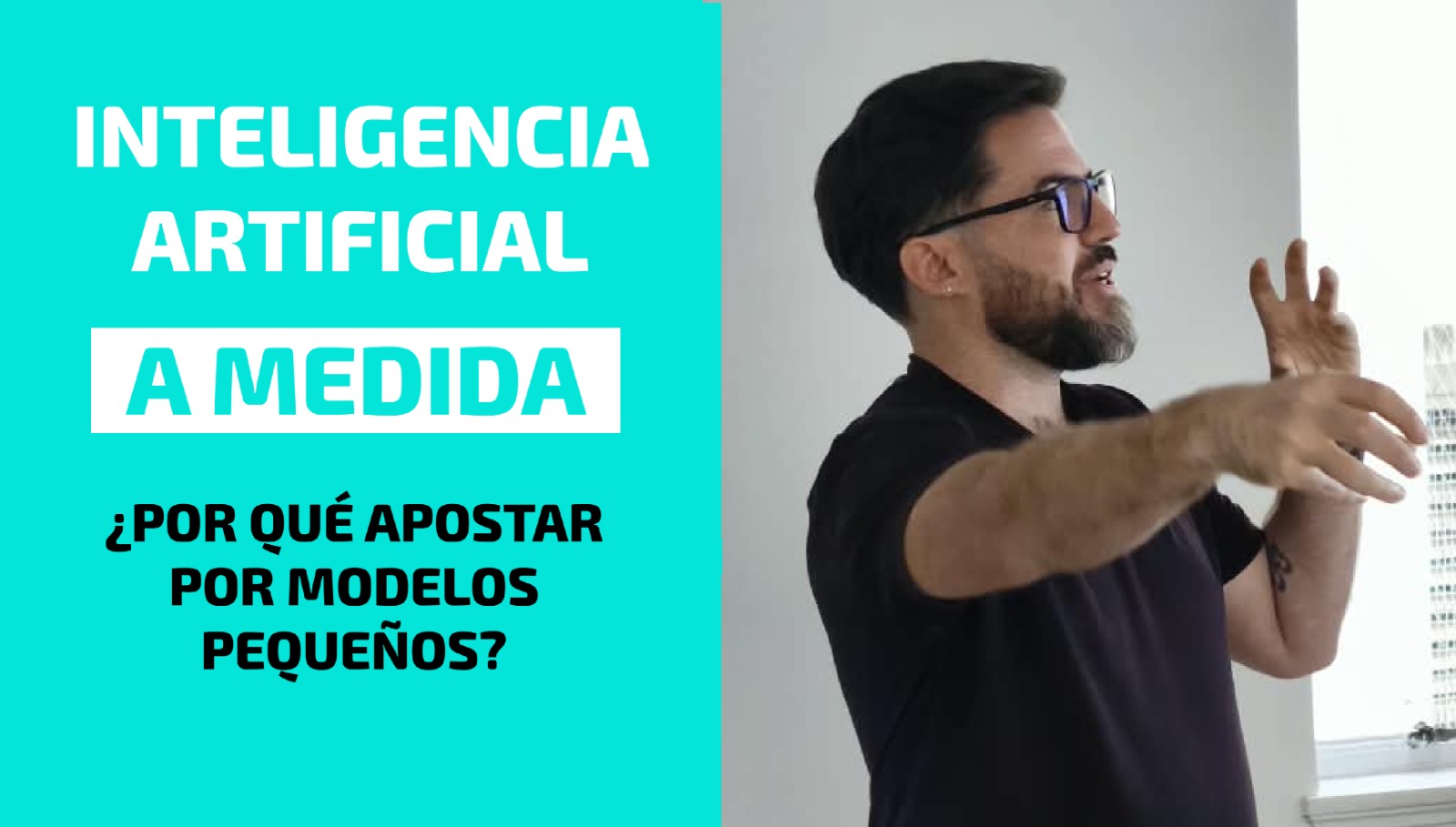
The offices of the Heinrich Böll Foundation in Buenos Aires hosted our talk “Tailor-Made Artificial Intelligence,” delivered by Matías Bordone—a Computer Science graduate, industry programmer specializing in intelligent agents, and Ph.D. candidate in Computer Science focusing on AI at FAMAF (National University of Córdoba). Bordone also highlighted his active involvement in Argentina’s Cibercirujas collective. Throughout the session, he offered a critical perspective on the current state of technology while presenting proactive strategies for organizations, universities, and communities to achieve technological autonomy.
To establish a conceptual foundation, Bordone contrasted traditional software engineering with machine learning. While classical programming relies on explicit, developer-written rules to process data, machine learning analyzes datasets and inferences to identify patterns and generate underlying rules. Turning to Large Language Models (LLMs), he explained that they rely on statistical probabilities to predict subsequent words based on massive volumes of text. Bordone debunked the notion that this technology possesses an independent mind, emphasizing the fundamental nature of these systems: “Machines do not think… they are systems that learn patterns.” At the hardware level, he detailed the role of weights and parameters, alongside the physical constraints of RAM, CPUs, and GPUs, underscoring the vast computational gap: “To run a frontier model today, we need the equivalent of 80 laptops working together.”
The second half of the presentation addressed the challenges posed by hegemonic AI and explored pathways toward digital sovereignty. Bordone outlined the key risks of proprietary models: privacy loss, vendor lock-in, lack of transparency, data extractivism, and significant environmental and material impacts. In response, he examined the criteria set by the Open Source Initiative (OSI) for defining open artificial intelligence, questioning false claims of open-source software when only model weights are made public. As a concrete alternative to corporate monopolies, he advocated for the adoption of Small Language Models (SLMs) capable of running locally. In this context, he highlighted the importance of demystifying hardware scale, arguing that “publishing massive weights may legally grant access, but it does not materially democratize the capacity for actual deployment and adoption.”
On practical implementation, the speaker introduced a framework of “degrees of adoption” for organizations. This spectrum ranges from local execution using graphical interface tools like LM Studio, to employing Retrieval-Augmented Generation (RAG) for querying internal documentation, up to building intelligent agents, agentic systems, or fine-tuning models for specialized tasks. Defining automation capabilities in this domain, he noted that “an agent is software capable of planning and making decisions when executing tasks.” He illustrated the feasibility of local solutions with real-world examples, including AymurAI—developed by Datagénero to anonymize legal documents using a model of just 450 MB—and his own experiment with Tiny Stories, where he successfully trained a 7-million-parameter model to generate Spanish children’s stories at 26 tokens per second on a 2010 Conectar Igualdad laptop equipped with only 1 GB of RAM.
To conclude, the event’s conceptual framework aligned with the core principles of the ciberciruja movement: repurposing existing infrastructure, designing within hardware constraints, and challenging market-driven dictates. Moving beyond the perceived necessity of acquiring cutting-edge commercial technology or relying on inaccessible external infrastructures, Bordone stressed that maximizing local resources is a transformative stance. He firmly asserted that “Model size is a political, economic, and technical decision,” urging communities to explicitly define the collective capabilities they wish to build. He summarized the central premise of the talk with a clear call to action: “We do not need bigger AI; we need appropriate, evaluable, and sustainable AI.”