

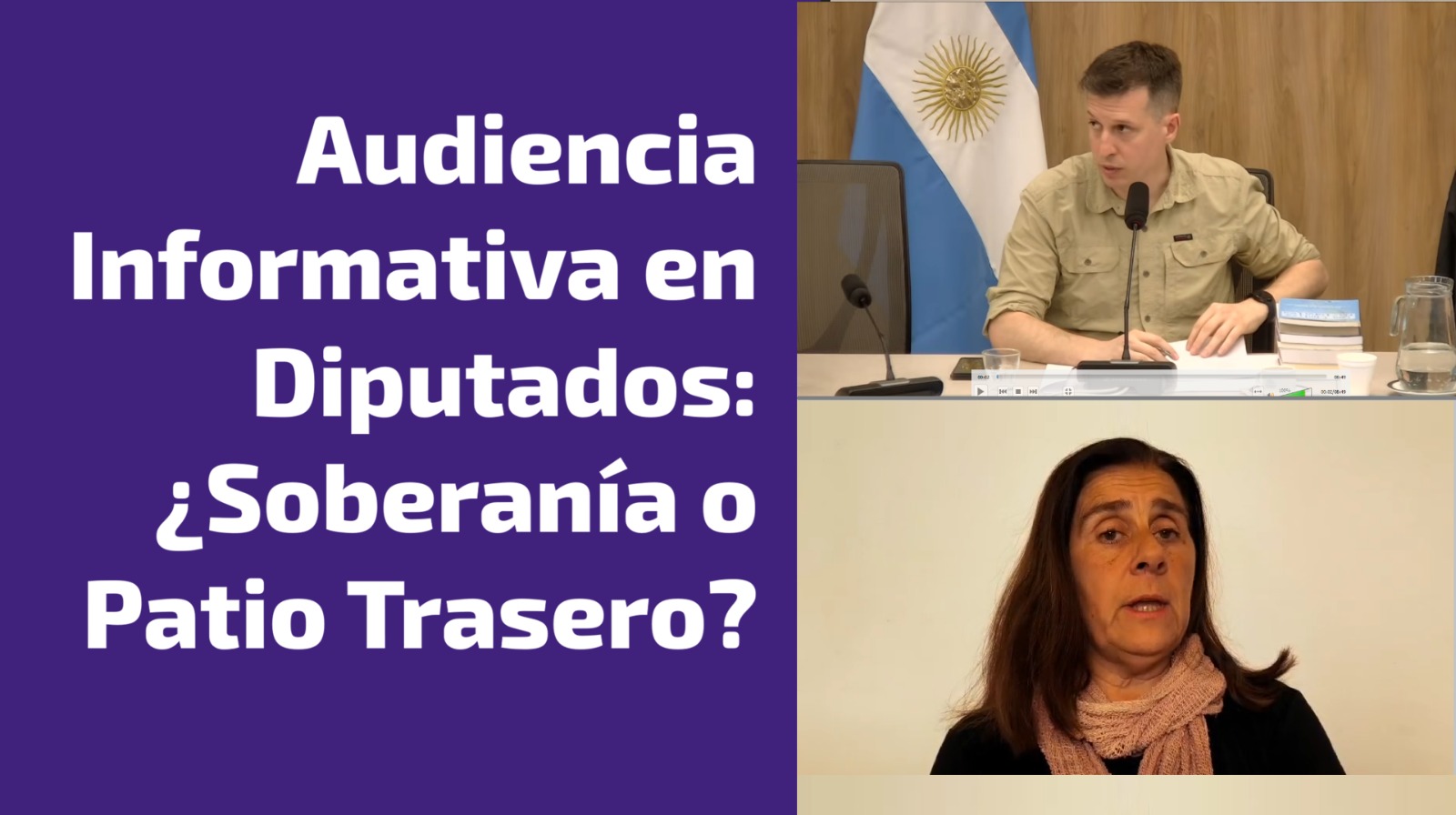
Fundación Vía Libre Participated in the Informational Hearing on the National Sovereignty Bill. Deputy Juan Marino invited various civil society organizations and stakeholders to share their perspectives during the informational hearing held this Friday, September 25, under the title: “Sovereignty or Backyard?”
The legislator from Unión por la Patria invited Vía Libre to offer its view on the National Sovereignty bill presented by the Executive Branch. In this context, our executive director, Beatriz Busaniche, presented a list of three central concerns regarding the proposal.
Regarding the creation of the National Security Council (CSN), we expressed our concern about its powers and operating conditions. The bill creates exceptional procedures similar to a State of Siege without judicial intervention, while also endowing the Council with the same secrecy clauses currently applying to intelligence activities. This approach conflicts with the transparency principles governing our legal system and with the right of access to public information—a fundamental right that is restricted arbitrarily and without legislative or judicial oversight.
A second concern presented at the Informational Hearing involves the role of civil society and the mechanisms the State assigns itself to monitor our organizations’ activities. The bill recycles certain aspects we previously criticized during the public hearing on the Lobbying Law. Under this new legislative tool, the government can frame organizations operating through international cooperation as suspicious and impose severe restrictions on the work of journalists and activists striving to raise awareness about public policies or opposing state policies and initiatives.
Finally, given time constraints, we addressed a sensitive topic: the definition of critical infrastructure. For many years, Vía Libre has emphasized the need for information security protocols to protect critical infrastructures vital to society, such as water distribution, energy, and health systems. Under no circumstances should this special protection fall under defense systems, as this implies the militarization of civilian infrastructure. An aggravating factor in this bill is the inclusion of foreign firms’ data centers—which could potentially set up in our territory—under this definition. The militarization of data centers is not new; it has already been observed in other jurisdictions. This aligns with categorizing civil society, grassroots, Indigenous, and environmental protection organizations as virtual enemies subject to surveillance, intelligence, and monitoring by the defense system.
In summary, we addressed three key concerns: the structure of the National Security Council, the attempt to endanger the work of Argentine civil society, and the classification of data centers as critical infrastructure leading to the virtual militarization of the territories where they establish themselves.