

by Margarita Trovato
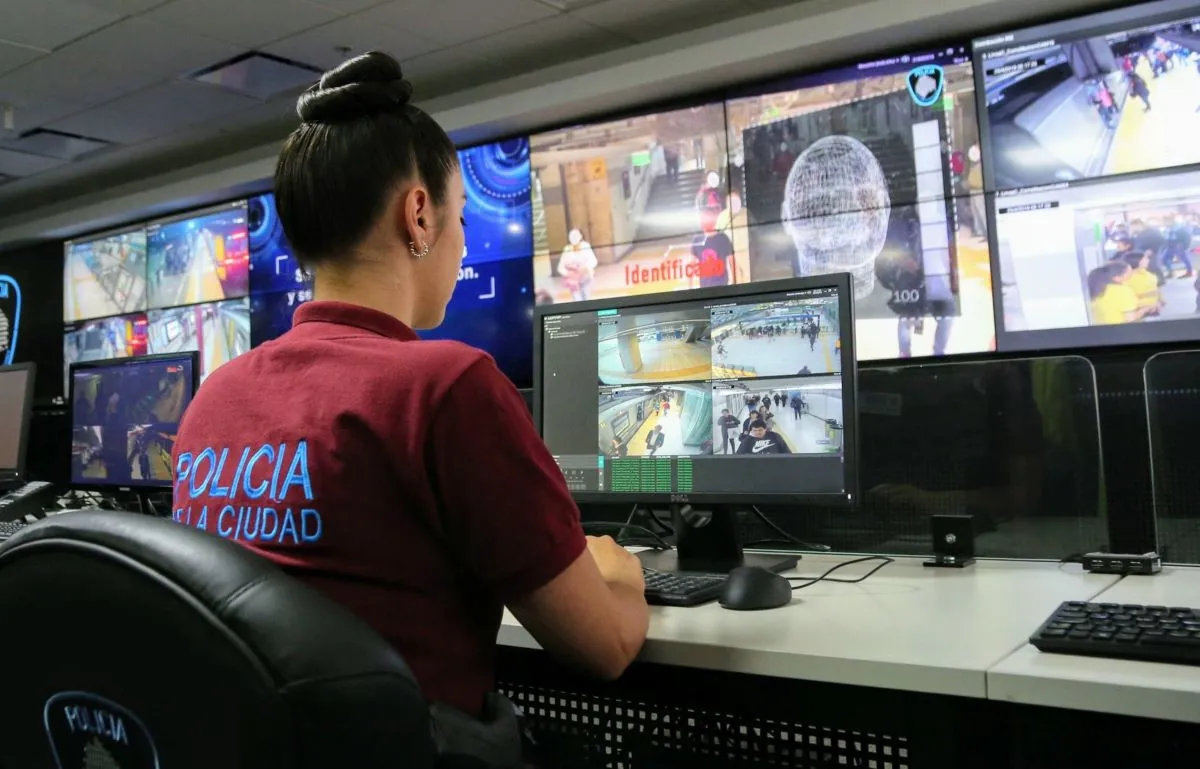
This Friday, September 25, a new hearing was held in the ongoing legal case over the use of facial recognition in the City of Buenos Aires. This session focused on a public tender promoted by the Buenos Aires City Government to procure a new facial recognition system to locate fugitives. Fundación Vía Libre participated as amicus curiae, alongside the Center for Legal and Social Studies (CELS, representing the plaintiffs), technical experts from the Faculty of Exact and Natural Sciences at the University of Buenos Aires (UBA), the Ministry of Security, the City’s Attorney General’s Office, and the Ombudsperson’s Office—one of the oversight bodies established by law for this system.
It should be recalled that the current system has been suspended since 2022, following a judicial order to audit it and assess its impact on fundamental rights. The City Government is now moving forward with a tender to procure a new system to replace it. During the hearing, the new proposal was debated based on the terms of reference that would govern the bidding process. The Ministry of Security presented technical details that, in its view, serve as safeguards for the new framework, providing more information than had been included in the administrative record submitted to the case file.
Providing broader context, technical expert Sebastián Uchitel explained that determining whether the system is secure and respectful of citizens’ rights requires more than evaluating the technology in isolation. Its safe operation also depends on how it is deployed in practice—including human intervention protocols, training, and police procedures—information that is not contained in the tender specifications. On this basis, participants discussed key points regarding its eventual implementation and deployment conditions, as well as other regulatory frameworks the City Government claims to have in place, such as protocols governing police action once the system becomes operational.
While the plaintiffs, the oversight body, and Vía Libre as amicus curiae commended the Government’s willingness to comply with previous judicial rulings and integrate their guidelines into a new system, we shared several significant concerns, some of them grave. One of the most highlighted flaws was that the tender specifications do not require a rigorous evaluation of the system’s algorithmic bias—a central ground for the suspension of the previous system. The current draft addresses bias with technical inaccuracy and leaves broad discretion, directly contradicting the City’s own Artificial Intelligence Guidelines, which the Ministry presented as a governing framework for this process.
Another heavily criticized aspect was the scope of the planned audit, which was also a pivotal requirement in previous judicial decisions. The current tender specifications only require a sworn affidavit from the winning vendor regarding “data integration processes,” without mandating an audit of the artificial intelligence model itself, the data used to train it, or its performance across different demographic groups.
Regarding privacy protection, concerns were raised that the personal data protection impact assessment required by the tender is conducted ex post, with no explicit criteria or standards set for the evaluation. We forcefully requested that the expectations for this assessment be clearly defined so that bidders provide clear and relevant information to properly evaluate its real impact on fundamental rights. The City Government proved particularly reticent on this point.
Participants also addressed concerns regarding a clause allowing the winning vendor to reuse the data it accesses to train its own systems—subject to approval by the City Government—without specifying any parameters or conditions for such authorization. The Ministry of Security responded that data reuse could only occur with explicit permission and within the terms allowed by the AI Guidelines, though it did not rule out the possibility.
These and other technical issues raise serious red flags about deploying such technologies under conditions similar to the ones currently suspended. The truth is that the current tender specifications—with their inaccuracies, errors, and ambiguities—grant such a wide margin of discretion that it seems improbable that its practical implementation will satisfy the declared safeguards, even assuming the best intentions to adhere to the standards established by the courts. Consequently, Vía Libre announced that we will submit written observations on the tender specifications, along with a proposal outlining the minimum criteria that any personal data protection impact assessment must include for systems of this nature.
We will continue to closely monitor this process, which sets a key precedent for the defense of fundamental rights against the deployment of mass surveillance technologies in public spaces.